 知微
fa45d8aa5f
知微
fa45d8aa5f
- health_checklist.json: 192.168.1.122→node122
- ocr_client.py: docstring IP→node122
- docs/market-data-requirements.md: IP→node122
- 所有API调用通过ProxyHandler({})绕过系统代理
  Privoxy对node122:18003返回500,直连正常
492 lines
20 KiB
Plaintext
492 lines
20 KiB
Plaintext
Metadata-Version: 2.4
|
||
Name: json_repair
|
||
Version: 0.61.1
|
||
Summary: A package to repair broken json strings
|
||
Author-email: Stefano Baccianella <4247706+mangiucugna@users.noreply.github.com>
|
||
License-Expression: MIT
|
||
Project-URL: Homepage, https://github.com/mangiucugna/json_repair/
|
||
Project-URL: Bug Tracker, https://github.com/mangiucugna/json_repair/issues
|
||
Project-URL: Live demo, https://mangiucugna.github.io/json_repair/
|
||
Keywords: JSON,REPAIR,LLM,PARSER
|
||
Classifier: Programming Language :: Python :: 3
|
||
Classifier: Operating System :: OS Independent
|
||
Requires-Python: >=3.10
|
||
Description-Content-Type: text/markdown
|
||
License-File: LICENSE
|
||
Provides-Extra: schema
|
||
Requires-Dist: jsonschema>=4.21; (python_full_version < "3.15.0a0" or python_full_version >= "3.15.0") and extra == "schema"
|
||
Requires-Dist: pydantic>=2; (python_full_version < "3.15.0a0" or python_full_version >= "3.15.0") and extra == "schema"
|
||
Dynamic: license-file
|
||
|
||
[](https://pypi.org/project/json-repair/)
|
||

|
||
[](https://pypi.org/project/json-repair/)
|
||
[](https://pepy.tech/projects/json-repair)
|
||
[](https://github.com/sponsors/mangiucugna)
|
||
[](https://github.com/mangiucugna/json_repair/stargazers)
|
||
|
||
English | [中文](https://github.com/mangiucugna/json_repair/blob/main/README.zh.md)
|
||
|
||
# json_repair
|
||
|
||
Repair malformed JSON from LLMs, APIs, logs, and user input in Python.
|
||
|
||
- Fix missing quotes, commas, brackets, comments, stray prose, and truncated values.
|
||
- Use it as a drop-in fallback for `json.loads()` or as a schema-guided repair step.
|
||
- Install with `pip install json-repair` or try the [live demo](https://mangiucugna.github.io/json_repair/).
|
||
|
||

|
||
|
||
---
|
||
|
||
## Quick example
|
||
|
||
```python
|
||
import json_repair
|
||
|
||
bad_json = '{"users":[{"name":"Ada","role":"admin",}],"ok":true'
|
||
decoded_object = json_repair.loads(bad_json)
|
||
|
||
# {'users': [{'name': 'Ada', 'role': 'admin'}], 'ok': True}
|
||
```
|
||
|
||
If `json_repair` saves you time, [star the repository](https://github.com/mangiucugna/json_repair) so more people can find it.
|
||
|
||
---
|
||
|
||
# Demo
|
||
If you are unsure whether this library will fix your specific problem, or simply want your JSON validated online, try one of these:
|
||
|
||
- Live demo: https://mangiucugna.github.io/json_repair/
|
||
- Audio overview: [NotebookLM introduction](https://notebooklm.google.com/notebook/05312bb3-f6f3-4e49-a99b-bd51db64520b/audio)
|
||
|
||
## Premium sponsors
|
||
- [Icana-AI](https://github.com/Icana-AI) Makers of CallCoach, the world's best Call Centre AI Coach. Visit [https://www.icana.ai/](https://www.icana.ai/)
|
||
- [mjharte](https://github.com/mjharte)
|
||
|
||
---
|
||
|
||
# Think about sponsoring this library!
|
||
This library is free for everyone and is maintained as a side project, so if it helps your work, consider becoming a sponsor: https://github.com/sponsors/mangiucugna
|
||
|
||
---
|
||
|
||
# Motivation
|
||
Some LLMs are a bit iffy when it comes to returning well formed JSON data, sometimes they skip a parentheses and sometimes they add some words in it, because that's what an LLM does.
|
||
Luckily, the mistakes LLMs make are simple enough to be fixed without destroying the content.
|
||
|
||
I searched for a lightweight python package that was able to reliably fix this problem but couldn't find any.
|
||
|
||
*So I wrote one*
|
||
|
||
# Supported use cases
|
||
|
||
### Fixing Syntax Errors in JSON
|
||
|
||
- Missing quotes, misplaced commas, unescaped characters, and incomplete key-value pairs.
|
||
- Missing quotation marks, improperly formatted values (true, false, null), and repairs corrupted key-value structures.
|
||
|
||
### Repairing Malformed JSON Arrays and Objects
|
||
|
||
- Incomplete or broken arrays/objects by adding necessary elements (e.g., commas, brackets) or default values (null, "").
|
||
- The library can process JSON that includes extra non-JSON characters like comments or improperly placed characters, cleaning them up while maintaining valid structure.
|
||
|
||
### Auto-Completion for Missing JSON Values
|
||
|
||
- Automatically completes missing values in JSON fields with reasonable defaults (like empty strings or null), ensuring validity.
|
||
|
||
# How to use
|
||
|
||
Install the library with pip
|
||
|
||
pip install json-repair
|
||
|
||
then you can use use it in your code like this
|
||
|
||
from json_repair import repair_json
|
||
|
||
good_json_string = repair_json(bad_json_string)
|
||
# If the string was super broken this will return an empty string
|
||
|
||
|
||
You can use this library to completely replace `json.loads()`:
|
||
|
||
import json_repair
|
||
|
||
decoded_object = json_repair.loads(json_string)
|
||
|
||
or just
|
||
|
||
import json_repair
|
||
|
||
decoded_object = json_repair.repair_json(json_string, return_objects=True)
|
||
|
||
### Avoid this antipattern
|
||
Some users of this library adopt the following pattern:
|
||
|
||
obj = {}
|
||
try:
|
||
obj = json.loads(string)
|
||
except json.JSONDecodeError as e:
|
||
obj = json_repair.loads(string)
|
||
...
|
||
|
||
This is wasteful because `json_repair` already does that strict `json.loads()` check for you by default. The normal flow is:
|
||
|
||
- try the built-in `json.loads()` / `json.load()` first
|
||
- if that succeeds, return the decoded object
|
||
- if that fails, run the repair parser
|
||
|
||
Use the default call unless you explicitly want to skip that initial validation step:
|
||
|
||
```python
|
||
import json_repair
|
||
|
||
decoded_object = json_repair.loads(json_string)
|
||
```
|
||
|
||
### Read json from a file or file descriptor
|
||
|
||
JSON repair provides also a drop-in replacement for `json.load()`:
|
||
|
||
import json_repair
|
||
|
||
try:
|
||
file_descriptor = open(fname, 'rb')
|
||
except OSError:
|
||
...
|
||
|
||
with file_descriptor:
|
||
decoded_object = json_repair.load(file_descriptor)
|
||
|
||
and another method to read from a file:
|
||
|
||
import json_repair
|
||
|
||
try:
|
||
decoded_object = json_repair.from_file(json_file)
|
||
except OSError:
|
||
...
|
||
except IOError:
|
||
...
|
||
|
||
Keep in mind that the library will not catch any IO-related exception and those will need to be managed by you
|
||
|
||
### Non-Latin characters
|
||
|
||
When working with non-Latin characters (such as Chinese, Japanese, or Korean), you need to pass `ensure_ascii=False` to `repair_json()` in order to preserve the non-Latin characters in the output.
|
||
|
||
Here's an example using Chinese characters:
|
||
|
||
repair_json("{'test_chinese_ascii':'统一码'}")
|
||
|
||
will return
|
||
|
||
{"test_chinese_ascii": "\u7edf\u4e00\u7801"}
|
||
|
||
Instead passing `ensure_ascii=False`:
|
||
|
||
repair_json("{'test_chinese_ascii':'统一码'}", ensure_ascii=False)
|
||
|
||
will return
|
||
|
||
{"test_chinese_ascii": "统一码"}
|
||
|
||
### JSON dumps parameters
|
||
|
||
More in general, `repair_json` will accept all parameters that `json.dumps` accepts and just pass them through (for example indent)
|
||
|
||
### Performance considerations
|
||
By default, `json_repair` first tries the standard-library JSON loader and only falls back to the repair parser when strict JSON parsing fails.
|
||
|
||
If you already know the input is invalid JSON and want to skip that initial validation step, pass `skip_json_loads=True`:
|
||
|
||
from json_repair import repair_json
|
||
|
||
good_json_string = repair_json(bad_json_string, skip_json_loads=True)
|
||
|
||
This is an explicit tradeoff:
|
||
|
||
- default behavior: validate with stdlib JSON first, then repair only if needed
|
||
- `skip_json_loads=True`: skip the validation fast path and go straight to the repair parser
|
||
|
||
Important: `skip_json_loads=True` is only for inputs you already know are invalid. If you force already-valid JSON through the repair parser, `json_repair` may still "repair" it and can change the resulting structure or values. If you need valid JSON to be preserved as-is, keep `skip_json_loads=False`.
|
||
|
||
`json_repair` intentionally keeps the validation path on the standard library. It does not auto-detect or auto-use third-party JSON libraries, which keeps behavior predictable and avoids extra overhead on the common path.
|
||
|
||
Some rules of thumb to use:
|
||
- Setting `return_objects=True` will always be faster because the parser returns an object already and it doesn't have serialize that object to JSON
|
||
- `skip_json_loads=True` is faster only if you 100% know that the string is not a valid JSON
|
||
- `skip_json_loads=True` is not a "faster but equivalent" mode for valid JSON; it intentionally bypasses the stdlib success path, so valid inputs should use the default behavior
|
||
- If you are having issues with escaping pass the string as **raw** string like: `r"string with escaping\""`
|
||
|
||
### When to use your own JSON library
|
||
|
||
If you want non-stdlib JSON semantics or a different performance profile, use your preferred JSON library yourself instead of expecting `json_repair` to switch parsers automatically. `orjson` is a common example people ask about, and the same pattern applies to any other JSON library.
|
||
|
||
Recommended patterns:
|
||
|
||
Strict JSON first, repair only if needed:
|
||
|
||
```python
|
||
import json_repair
|
||
|
||
decoded_object = json_repair.loads(json_string)
|
||
```
|
||
|
||
Known-bad input, so skip the validation step:
|
||
|
||
```python
|
||
from json_repair import repair_json
|
||
|
||
decoded_object = repair_json(bad_json_string, return_objects=True, skip_json_loads=True)
|
||
```
|
||
|
||
`orjson` first, `json_repair` only as a fallback:
|
||
|
||
```python
|
||
import json_repair
|
||
import orjson
|
||
|
||
try:
|
||
decoded_object = orjson.loads(json_string)
|
||
except orjson.JSONDecodeError:
|
||
decoded_object = json_repair.loads(json_string, skip_json_loads=True)
|
||
```
|
||
|
||
### Strict mode
|
||
|
||
By default `json_repair` does its best to “fix” input, even when the JSON is far from valid.
|
||
In some scenarios you want the opposite behavior and need the parser to error out instead of repairing; pass `strict=True` to `repair_json`, `loads`, `load`, or `from_file` to enable that mode:
|
||
|
||
```
|
||
from json_repair import repair_json
|
||
|
||
repair_json(bad_json_string, strict=True)
|
||
```
|
||
|
||
The CLI exposes the same behavior with `json_repair --strict input.json` (or piping data via stdin).
|
||
|
||
In strict mode the parser raises `ValueError` as soon as it encounters structural issues such as duplicate keys, missing `:` separators, empty keys/values introduced by stray commas, multiple top-level elements, or other ambiguous constructs. This is useful when you just need validation with friendlier error messages while still benefiting from json_repair’s resilience elsewhere in your stack.
|
||
|
||
Strict mode still honors `skip_json_loads=True`; combining them lets you skip the initial `json.loads` check but still enforce strict parsing rules.
|
||
|
||
### Schema-guided repairs
|
||
|
||
Schema-guided repairs are currently considered in beta. Bugs are to be expected.
|
||
|
||
You can guide repairs with a JSON Schema (or a Pydantic v2 model). When enabled, the parser will:
|
||
|
||
- Fill missing values (defaults, required fields).
|
||
- Coerce scalars where safe (e.g., `"1"` → `1` for integer fields, and `"yes"`/`"no"`/`1`/`0` for booleans).
|
||
- Drop properties/items that the schema disallows.
|
||
|
||
Schema mode can be selected with `schema_repair_mode`:
|
||
|
||
- `standard` (default): existing schema-guided behavior.
|
||
- `salvage`: includes `standard` and also:
|
||
- drops invalid array items when individual items cannot be repaired;
|
||
- maps arrays to objects by property order when schema/object shape is unambiguous.
|
||
- unwraps a root single-item array to an object when the root schema expects an object (`[{...}] -> {...}`);
|
||
- fills missing required fields only when a safe value can be inferred (`default`, `const`, first `enum`, or empty array/object when allowed by schema constraints).
|
||
|
||
This is especially useful when you need deterministic, schema-valid outputs for downstream validation, storage, or typed processing. If the input cannot be repaired to satisfy the schema, `json_repair` raises `ValueError`.
|
||
|
||
Install the optional dependencies:
|
||
|
||
pip install 'json-repair[schema]'
|
||
|
||
(For CLI usage, you can also use `pipx install 'json-repair[schema]'`.)
|
||
|
||
When `schema` is provided, schema guidance is always applied (for both valid and invalid JSON). Schema guidance is mutually exclusive with `strict=True`.
|
||
|
||
```
|
||
from json_repair import repair_json
|
||
|
||
schema = {
|
||
"type": "object",
|
||
"properties": {"value": {"type": "integer"}},
|
||
"required": ["value"],
|
||
}
|
||
|
||
repair_json('{"value": "1"}', schema=schema, return_objects=True)
|
||
|
||
repair_json(
|
||
'{"items":[{"id":1,"score":85.6},{"id":2,"score":"N/A"}]}',
|
||
schema={
|
||
"type": "object",
|
||
"properties": {
|
||
"items": {
|
||
"type": "array",
|
||
"items": {
|
||
"type": "object",
|
||
"properties": {"id": {"type": "integer"}, "score": {"type": "number"}},
|
||
"required": ["id", "score"],
|
||
},
|
||
}
|
||
},
|
||
"required": ["items"],
|
||
},
|
||
schema_repair_mode="salvage",
|
||
return_objects=True,
|
||
)
|
||
```
|
||
|
||
Pydantic v2 model example:
|
||
|
||
```
|
||
from pydantic import BaseModel, Field
|
||
from json_repair import repair_json
|
||
|
||
|
||
class Payload(BaseModel):
|
||
value: int
|
||
tags: list[str] = Field(default_factory=list)
|
||
|
||
|
||
repair_json(
|
||
'{"value": "1", "tags": }',
|
||
schema=Payload,
|
||
skip_json_loads=True,
|
||
return_objects=True,
|
||
)
|
||
```
|
||
|
||
### Use json_repair with streaming
|
||
|
||
Sometimes you are streaming some data and want to repair the JSON coming from it. Normally this won't work but you can pass `stream_stable` to `repair_json()` or `loads()` to make it work:
|
||
|
||
```
|
||
stream_output = repair_json(stream_input, stream_stable=True)
|
||
```
|
||
|
||
### More integration examples
|
||
|
||
If you want copy-paste examples for real applications, see [examples/README.md](https://github.com/mangiucugna/json_repair/blob/main/examples/README.md):
|
||
|
||
- [repair_llm_output.py](https://github.com/mangiucugna/json_repair/blob/main/examples/repair_llm_output.py) repairs markdown-wrapped or prose-wrapped model output.
|
||
- [pydantic_schema.py](https://github.com/mangiucugna/json_repair/blob/main/examples/pydantic_schema.py) uses a Pydantic v2 model as schema guidance.
|
||
- [stream_stable.py](https://github.com/mangiucugna/json_repair/blob/main/examples/stream_stable.py) keeps partial JSON stable during streaming.
|
||
- [fastapi_app.py](https://github.com/mangiucugna/json_repair/blob/main/examples/fastapi_app.py) drops the repair step into a FastAPI endpoint.
|
||
|
||
### Use json_repair from CLI
|
||
|
||
Install the library for command-line with:
|
||
```
|
||
pipx install json-repair
|
||
```
|
||
to know all options available:
|
||
```
|
||
$ json_repair -h
|
||
usage: json_repair [-h] [-i] [-o TARGET] [--ensure_ascii] [--indent INDENT]
|
||
[--skip-json-loads] [--schema SCHEMA] [--schema-model MODEL]
|
||
[--strict] [--schema-repair-mode {standard,salvage}] [filename]
|
||
|
||
Repair and parse JSON files.
|
||
|
||
positional arguments:
|
||
filename The JSON file to repair (if omitted, reads from stdin)
|
||
|
||
options:
|
||
-h, --help show this help message and exit
|
||
-i, --inline Replace the file inline instead of returning the output to stdout
|
||
-o TARGET, --output TARGET
|
||
If specified, the output will be written to TARGET filename instead of stdout
|
||
--ensure_ascii Pass ensure_ascii=True to json.dumps()
|
||
--indent INDENT Number of spaces for indentation (Default 2)
|
||
--skip-json-loads Skip initial json.loads validation
|
||
--schema SCHEMA Path to a JSON Schema file that guides repairs
|
||
--schema-model MODEL Pydantic v2 model in 'module:ClassName' form that guides repairs
|
||
--strict Raise on duplicate keys, missing separators, empty keys/values, and similar structural issues instead of repairing them
|
||
--schema-repair-mode {standard,salvage}
|
||
Schema repair mode: standard (default) or salvage (best-effort array/object salvage)
|
||
```
|
||
|
||
## Adding to requirements
|
||
**Please pin this library only on the major version!**
|
||
|
||
We use TDD and strict semantic versioning, there will be frequent updates and no breaking changes in minor and patch versions.
|
||
To ensure that you only pin the major version of this library in your `requirements.txt`, specify the package name followed by the major version and a wildcard for minor and patch versions. For example:
|
||
|
||
json_repair==0.*
|
||
|
||
In this example, any version that starts with `0.` will be acceptable, allowing for updates on minor and patch versions.
|
||
|
||
---
|
||
# How to cite
|
||
If you are using this library in your academic work (as I know many folks are) please find the BibTex here:
|
||
|
||
@software{Baccianella_JSON_Repair_-_2025,
|
||
author = "Stefano {Baccianella}",
|
||
month = "feb",
|
||
title = "JSON Repair - A python module to repair invalid JSON, commonly used to parse the output of LLMs",
|
||
url = "https://github.com/mangiucugna/json_repair",
|
||
version = "0.39.1",
|
||
year = 2025
|
||
}
|
||
|
||
Thank you for citing my work and please send me a link to the paper if you can!
|
||
|
||
---
|
||
|
||
# How it works
|
||
This module will parse the JSON file following the BNF definition:
|
||
|
||
<json> ::= <primitive> | <container>
|
||
|
||
<primitive> ::= <number> | <string> | <boolean>
|
||
; Where:
|
||
; <number> is a valid real number expressed in one of a number of given formats
|
||
; <string> is a string of valid characters enclosed in quotes
|
||
; <boolean> is one of the literal strings 'true', 'false', or 'null' (unquoted)
|
||
|
||
<container> ::= <object> | <array>
|
||
<array> ::= '[' [ <json> *(', ' <json>) ] ']' ; A sequence of JSON values separated by commas
|
||
<object> ::= '{' [ <member> *(', ' <member>) ] '}' ; A sequence of 'members'
|
||
<member> ::= <string> ': ' <json> ; A pair consisting of a name, and a JSON value
|
||
|
||
If something is wrong (a missing parentheses or quotes for example) it will use a few simple heuristics to fix the JSON string:
|
||
- Add the missing parentheses if the parser believes that the array or object should be closed
|
||
- Quote strings or add missing single quotes
|
||
- Adjust whitespaces and remove line breaks
|
||
|
||
I am sure some corner cases will be missing, if you have examples please open an issue or even better push a PR
|
||
|
||
# Contributing
|
||
If you want to contribute, start with `CONTRIBUTING.md` and read the Code Wiki writeup for a tour of the codebase and key entry points: https://codewiki.google/github.com/mangiucugna/json_repair
|
||
|
||
# How to develop
|
||
Use `uv` to set up the dev environment and run tooling:
|
||
|
||
uv sync --group dev
|
||
uv run pre-commit run --all-files
|
||
uv run pytest
|
||
|
||
Make sure that the Github Actions running after pushing a new commit don't fail as well.
|
||
|
||
# How to release
|
||
You will need owner access to this repository
|
||
- Edit `pyproject.toml` and update the version number appropriately using `semver` notation
|
||
- **Commit and push all changes to the repository before continuing or the next steps will fail**
|
||
- Run `python -m build`
|
||
- Create a new release in Github, making sure to tag all the issues solved and contributors. Create the new tag, same as the one in the build configuration
|
||
- Once the release is created, a new Github Actions workflow will start to publish on Pypi, make sure it didn't fail
|
||
|
||
## Docs demo API deployment (PythonAnywhere)
|
||
- The docs site is deployed by GitHub Pages (`pages-build-deployment`).
|
||
- After a successful Pages deployment on `main`, `.github/workflows/pythonanywhere-sync.yml` uploads `docs/app.py` to PythonAnywhere at `/home/mangiucugna/json_repair/app.py` and reloads `mangiucugna.pythonanywhere.com`.
|
||
- Required repository Actions secret: PythonAnywhere API token (`PYTHONANYWHERE_API_TOKEN`).
|
||
|
||
---
|
||
# Repair JSON in other programming languages
|
||
- Typescript: https://github.com/josdejong/jsonrepair
|
||
- Go: https://github.com/RealAlexandreAI/json-repair
|
||
- Ruby: https://github.com/sashazykov/json-repair-rb
|
||
- Rust: https://github.com/oramasearch/llm_json
|
||
- R: https://github.com/cgxjdzz/jsonRepair
|
||
- Java: https://github.com/du00cs/json-repairj
|
||
---
|
||
## Star History
|
||
|
||
[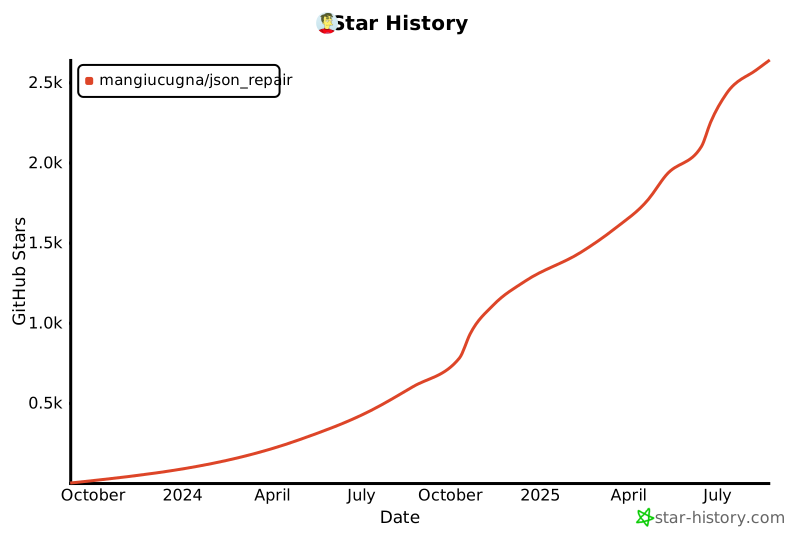](https://star-history.com/#mangiucugna/json_repair&Date)
|